Introduction
When selecting alloys for custom extrusion projects, engineers and procurement teams frequently balance 6061 vs 6063 aluminum. The engineering decision comes down to a fundamental tradeoff: structural load-bearing capacity and post-extrusion CNC machinability versus profile geometric complexity, thin-wall extrudability, and cosmetic surface finishing consistency.
Both alloys belong to the 6xxx series (magnesium-silicon heat-treatable alloys) and serve as the backbone of industrial extrusion. However, selecting an alloy strictly based on raw tensile strength values from a generic datasheet often causes manufacturing friction downstream. Forcing high-strength alloys through complex thin-walled dies leads to high press tonnage demands, premature die wear, slower line speeds, and finishing scrap.
This guide evaluates the mechanical specifications of ASTM B221 alongside real-world press shop operations, secondary machining considerations, and finishing yield metrics to help engineering teams optimize profile designs for manufacturability and total component cost.
6061 vs 6063: Mechanical & Process Comparison Table
The mechanical properties listed below represent minimum requirements specified by ASTM B221-23 for extruded profiles.
Applicability Note: Actual production performance depends on profile wall thickness variations, die geometry, quench rate at the press run-out, and artificial aging parameters.
| Property / Engineering Parameter |
6061 Aluminum (T6 Temper) |
6063 Aluminum (T5 Temper) |
| Yield Strength (0.2% Offset, Min.) |
240–276 MPa (35–40 ksi) |
110–145 MPa (16–21 ksi) |
| Tensile Strength (Min.) |
260–310 MPa (38–45 ksi) |
150–186 MPa (22–27 ksi) |
| Elongation in 2 in. / 50 mm (Min.) |
8% – 10% |
8% – 10% |
| Modulus of Elasticity (Stiffness) |
68.9 GPa (10.0 × 10³ ksi) |
68.3 GPa (9.9 × 10³ ksi) |
| Extrudability & Line Speed |
Baseline (typically 10–25 m/min) |
Up to 1.5× – 2.0× faster than 6061 |
| Recommended Minimum Wall Thickness |
~1.2 mm to 1.5 mm (press-dependent) |
Down to ~0.8 mm to 1.0 mm |
| Tooling & Die Life Expectancy |
Baseline (higher friction, accelerated die wear) |
Extended (lower extrusion pressure, extended die life) |
| Post-Extrusion CNC Machinability |
Superior (clean chip evacuation, tight tolerances) |
Moderate (gummy chips, burr formation at edges) |
| Decorative Anodizing Quality |
Functional grade (prone to micro-streaks/color drift) |
Architectural/Decorative grade (uniform luster) |
| Raw Billet Cost Index |
Moderate premium |
Baseline industrial pricing |
Why Alloy Selection Dictates Total Manufacturing Cost
A common procurement mistake is calculating part cost solely from raw billet material pricing. In custom profile production, alloy chemistry dictates extrusion speed, die maintenance frequency, scrap rates, and downstream machining cycles:
Total Part Cost = Raw Material + Tooling Amortization + Press Machine Hours + CNC Secondary Operations + Finishing Scrap
Technical guidelines from the Aluminum Extruders Council (AEC) indicate that 6063 contains lower total alloying additions—specifically lower copper, magnesium, and iron—reducing resistance to hot deformation within the die bearing channels. Specifying 6061 on complex profiles with tight tolerances or thin fins increases extrusion tonnage, necessitates frequent die adjustments, and lowers press output, which often offsets any expected material-only cost calculations.
6061 Aluminum Extrusion: Structural Strength & Precision Machining
6061 is the standard choice for load-bearing frameworks, mounting brackets, transportation equipment, and parts requiring precision secondary machining.
Key Performance Characteristics
- Load-Bearing Strength: In the peak-aged T6 temper, 6061 provides roughly double the yield strength of 6063-T5. For structural chassis members, crane rails, and platforms subject to cyclic loads or mechanical fastening, 6061 offers the necessary mechanical margin.
- Superior CNC Machinability: With its balanced silicon, magnesium, and trace copper content, 6061 cuts cleanly with short, brittle chips during drilling, milling, and thread tapping. For extrusions with milled mounting pockets or tapped holes, review our precision CNC machining services to see how 6061 maintains dimensional stability and minimizes edge burrs.
Extrusion Limitations
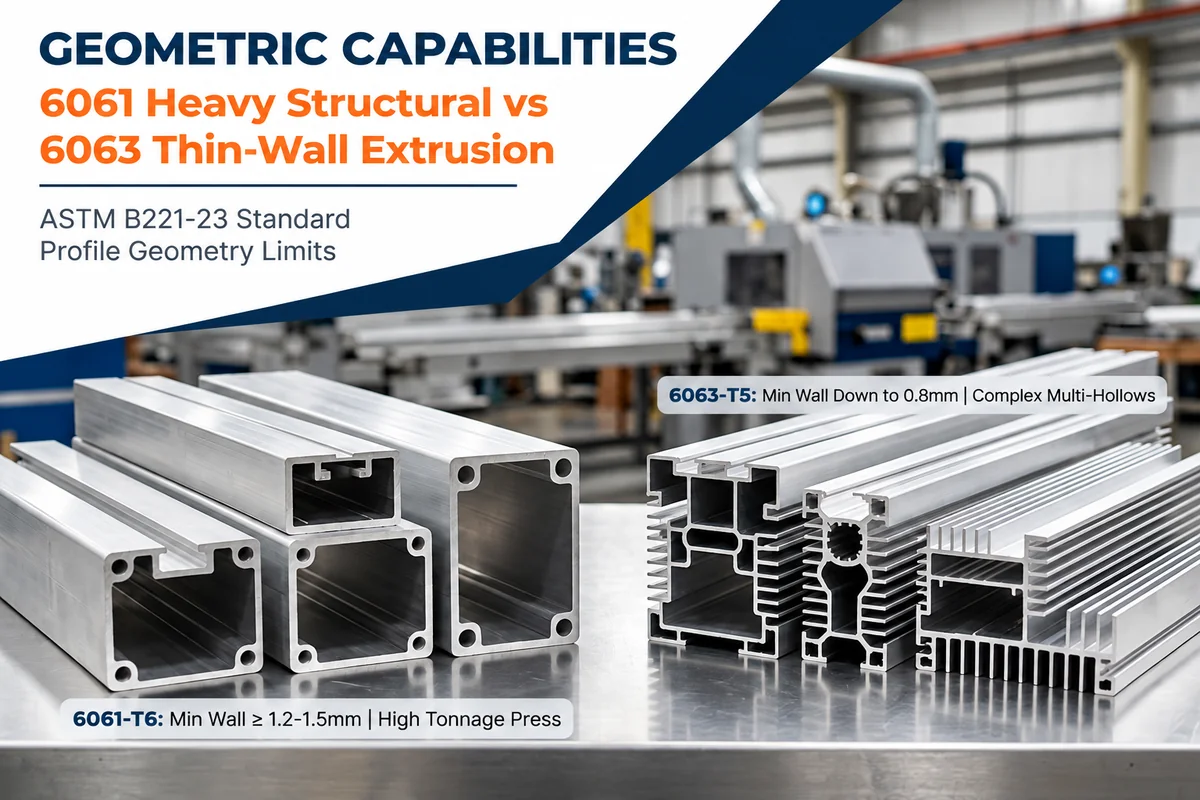
- Flow Resistance & Tooling Wear: 6061 requires significantly higher extrusion pressure. Profiles with wall thicknesses below 1.2 mm or high extrusion ratios increase the likelihood of die deflection, tearing on sharp corners, and shorter die life.
- Quench Sensitivity: Achieving minimum T6 mechanical properties demands rapid cooling (forced water quench or severe water mist) right after the die exit. This rapid thermal transition can introduce longitudinal warp or dimensional distortion in asymmetrical cross-sections.
6063 Aluminum Extrusion: Complex Geometries & Surface Consistency
Known as the standard extrusion alloy, 6063 is widely used for architectural extrusions, heat sinks, lighting housings, pneumatic cylinders, and consumer-facing assemblies.
Key Performance Characteristics
- Extrudability & Thin-Wall Capability: 6063 flows uniformly under moderate press tonnage, making it possible to form complex hollow sections, thin cooling fins (down to 0.8 mm), and snap-fit interlocks. Press lines run at substantially faster output speeds while preserving die bearing surfaces.
- High-Quality Cosmetic Surface: With iron held under 0.35% and trace copper minimal, 6063 minimizes intermetallic particle segregation. It creates an even, grain-free finish in clear and colored sulfuric anodizing systems.
Limitations
- Lower Mechanical Threshold: 6063-T5 is unsuitable for heavy structural loads. Even when artificially aged to a T6 condition (yielding roughly 170–200 MPa), its shear and tensile limits stay 25–30% lower than 6061-T6.
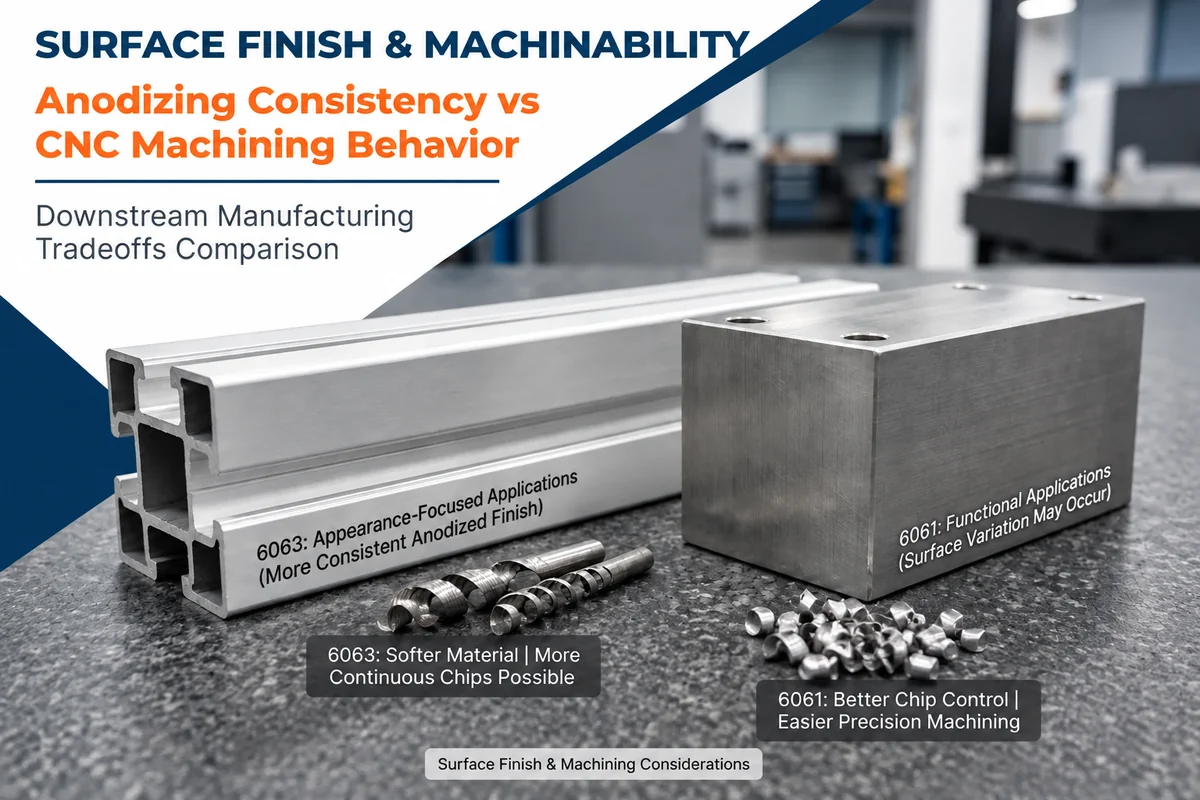
- Gummy Machining Behavior: 6063 tends to produce long, stringy chips during machining, which can wrap around cutters and form burrs around drilled holes. It requires specific tool geometries and chip-breaker designs during CNC milling.
Surface Finishing & Anodizing Performance
Cosmetic anodizing yield depends directly on base alloy chemistry:
- 6063 (Decorative Grade): The uniform microstructure ensures consistent specular reflectivity, deep dye uptake, and minimal batch-to-batch variation. For customer-facing trims or consumer goods, browse our anodizing and surface finishing services to evaluate Type II sulfuric and clear anodizing specifications.
- 6061 (Functional Grade): 6061 handles industrial corrosion protection and Type III hardcoat anodizing well. However, broad, flat profile faces often show subtle grain boundaries, die streaks, or a slight yellowish-gray tint after anodizing, making it less suitable for high-end decorative surfaces.
Total Manufacturing Cost & Sourcing Tradeoffs
Evaluate these three variables across the production chain before settling on an extrusion alloy:
- Tooling Investment & Tool Life: Dies for 6063 cost less to configure and last roughly 30% to 50% longer between EDM recutting cycles than comparable 6061 tooling.
- Press Line Productivity: 6063 can run at higher linear speeds, reducing billable press machine hours.
- Secondary Machining Cycle Times: When profiles require extensive milling, drilling, and pocketing, 6061 cuts faster and extends tool insert life, which often offsets its raw material cost premium.
Explore our custom aluminum extrusion capabilities to match profile geometries, tonnage envelopes, and target run sizes with the appropriate alloy choice.
Practical Engineering Decision Matrix
Use this checklist during preliminary CAD development:
Choose 6061 if:
- The profile serves as a primary structural support, load-bearing crossbar, or equipment base.
- Extensive CNC milling, precision boring, or thread tapping is required after extrusion.
- High joint-bearing strength and resistance to thread strip-out are critical.
- The profile geometry features uniform wall thickness (>1.5 mm) and moderate complexity.
Choose 6063 if:
- The profile features complex multi-void hollows, tight radiator fins, or snap-fit assemblies.
- Decorative anodizing consistency, uniform gloss, and aesthetic quality are central customer requirements.
- Thin-wall designs (0.8–1.2 mm) are required to reduce linear weight without compromising functionality.
- Production volumes are high and minimizing per-meter extrusion cost is critical.
Engineering Tip: The Elastic Modulus Myth Engineers sometimes swap 6063 for 6061 to fix an extrusion beam that flexes too much under load. However, both 6061 and 6063 share nearly identical elastic modulus values (~68.9 GPa vs. ~68.3 GPa). Switching to 6061 will not reduce elastic deflection under bending loads. To reduce deflection, adjust the profile's moment of inertia by adding ribs or increasing vertical web height.
3 Costly Alloy Selection Pitfalls to Avoid
- Specifying 6061 on Ultra-Thin Hollow Profiles: Forcing 6061 into complex, thin-walled shapes can cause die bridge breakage, profile surface tearing, and high scrap rates. Consider keeping 6063 and thickening high-stress radii instead.
- Omitting the Temper Callout on 2D Drawings: Calling out "6061" without specifying "-T6" risks receiving as-extruded (-F) or annealed (-O) profiles with less than half the expected yield strength.
- Using 6061 for Visible Decorative Faces: Selecting 6061 for minor strength gains on large visual panels frequently leads to surface rejects from visible grain lines and uneven anodizing color.
For geometric design guidelines, review our comprehensive Aluminum Extrusion Design Guide.
Conclusion & DFM Support
6061 and 6063 serve distinct engineering roles in extrusion manufacturing. 6061 provides structural strength, fatigue resistance, and predictable CNC machinability. 6063 delivers superior material flow for intricate geometry, thin-wall sections, and uniform cosmetic anodizing.
Before finalizing tooling investments, contact our engineering team to review your 2D and 3D CAD files. We provide comprehensive DFM evaluations covering die feasibility, press speed estimates, and secondary processing costs to ensure your extrusions perform reliably in production.
References & Sources
 Have a Custom Aluminum Project?