Aluminum extrusion profiles are formed by forcing heated, softened aluminum through a shaped die, which means the range of achievable cross-sections is extremely broad. That flexibility is why extruded aluminum profiles show up in window frames, automation frames, and electronics heat sinks alike. This guide maps the landscape: the structural types of aluminum profiles, the shape families you’ll encounter in a supplier’s catalog or a custom drawing, where each is typically used, and a short overview of the design factors that affect whether a given profile is straightforward or difficult to produce.
The Three Structural Types of Aluminum Profiles
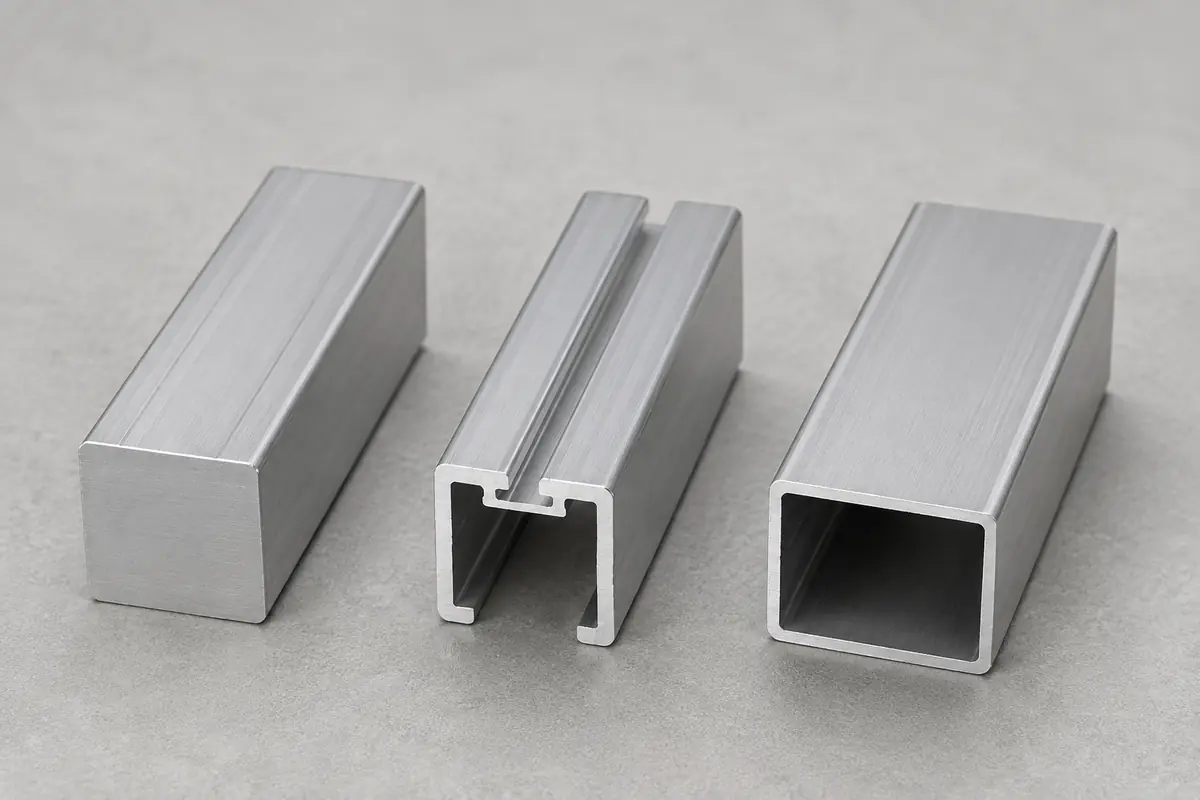
Extruded aluminum profiles generally fall into one of three structural categories, and the category itself says a lot about how the profile will be tooled and where it tends to be used.
| Type |
Definition |
Typical Use |
| Solid profile |
No internal cavity — flat bar, rod, angle, or open channel |
Brackets, trim, structural angles, simple frames |
| Hollow profile |
Fully enclosed internal cavity (round, square, or custom) |
Tubing, structural columns, enclosures, wire/cable routing |
| Semi-hollow profile |
Partially encloses an open cavity; whether a section qualifies as semi-hollow depends on opening size, void area, and the die’s tongue ratio |
Channels needing a captured edge — window sash, track systems, snap-fit housings |
Hollow profiles typically require a die with a mandrel, bridge, or porthole construction to form the enclosed cavity. Semi-hollow profiles present a different manufacturing challenge — the limiting factor is usually the die tongue’s dimensions and stiffness rather than the cavity itself — and tooling difficulty for both tends to run higher than for an equivalent solid section. In practice, the solid/semi-hollow/hollow boundary isn’t always obvious from a drawing alone; it’s worth confirming classification with your extruder before finalizing a design.
Common Aluminum Profile Shape Families
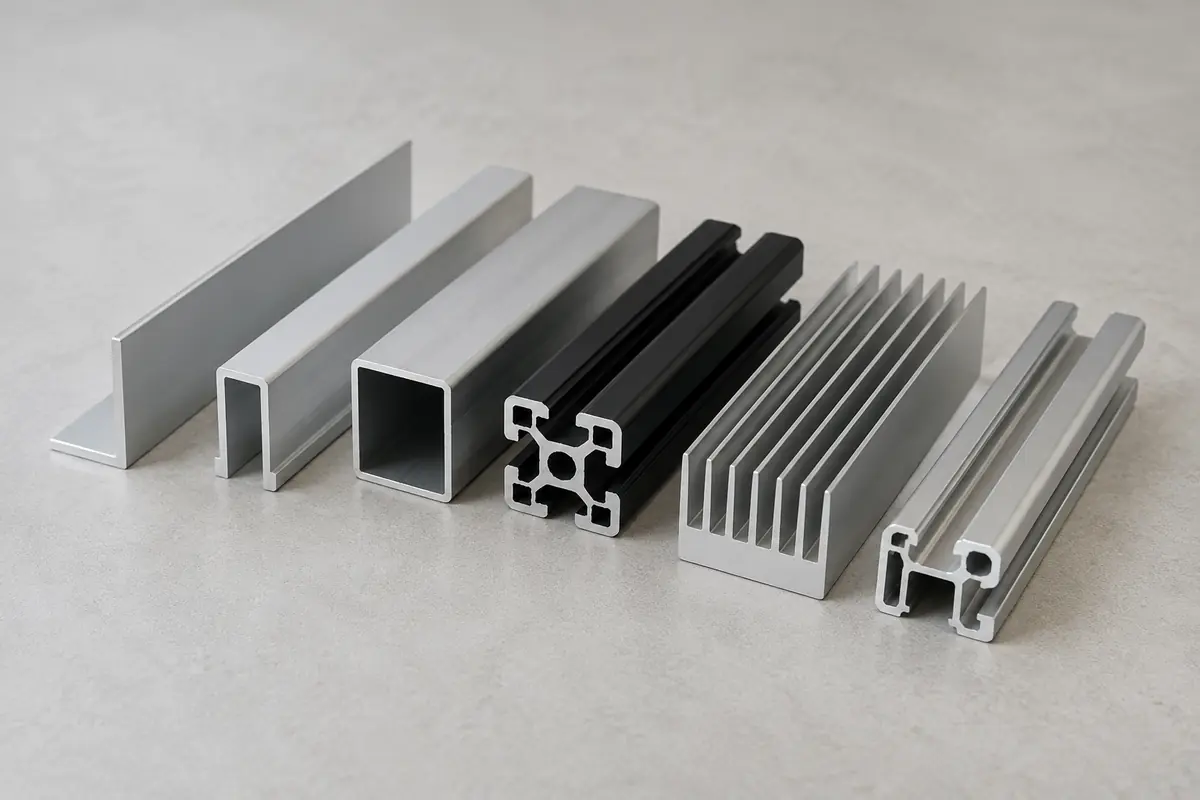
Most catalog and custom aluminum extrusion profiles fall into a handful of recognizable shape families:
- Angles and channels — L- and U-shaped aluminum sections used as structural framing members, edge trim, or mounting rails.
- T-slot extrusion profiles — sections built around one or more standardized T-slots that accept T-nuts, sliding brackets, and connectors for modular assembly. T-slot design isn’t limited to hollow sections; the defining feature is the slot geometry and its modular connection capability, not the overall cross-section shape. This family is the backbone of most automation frames and machine guarding.
- Tubing (round, square, rectangular) — hollow structural aluminum profiles used for legs, columns, and handrails.
- Heat sink profiles — sections with multiple thin fins extruded from a common base, designed to maximize surface area for passive cooling in electronics and LED fixtures.
- Architectural and glazing profiles — window, door, and curtain-wall sections. Their structural form varies by design; a given profile might be solid, semi-hollow, or multi-cavity hollow, and typically includes weatherstrip channels and glass or panel retention features.
- Multi-function custom profiles — sections that combine mounting features, wire channels, and structural elements into a single cross-section, replacing what would otherwise require several separate parts.
Where Extruded Aluminum Profiles Get Used
| Industry |
Typical Profile Type |
Why Aluminum Extrusion |
| Automation and robotics |
T-slot framing, structural angles |
Modular assembly, favorable strength-to-weight ratio, easy reconfiguration |
| Solar and renewable energy |
Mounting rails, structural channels |
Outdoor corrosion resistance; extrusion economics favor long production runs |
| Energy storage / battery systems |
Hollow structural housings, thermal-management channels |
Lightweight structural protection, with cooling channels integrated directly into the section |
| Electronics and LED lighting |
Heat sink profiles |
High surface-area-to-weight ratio for passive cooling |
| Architecture and construction |
Window, door, and curtain-wall profiles |
Weather resistance, finish quality, long service life |
| Transportation |
Structural and semi-structural framing |
Weight savings translate directly into fuel or range efficiency |
Standard Catalog Profiles vs. Custom Aluminum Extrusions
Most projects start by asking whether an existing catalog profile will work or whether the application calls for a custom die. Standard aluminum extrusion profiles carry no tooling charge and typically ship faster, but they’re generic — you may need extra brackets or connectors to achieve what a custom section could do in a single piece. Whether custom tooling is worth it shouldn’t be decided by volume alone; it comes down to comparing the one-time die investment against savings in material utilization, secondary machining, connector hardware, and assembly labor across your expected annual usage. That comparison is covered in more detail in our Aluminum Extrusion Design Guide for Engineers.
Design Considerations at a Glance
Not every profile shape is equally easy to produce. A few factors have an outsized effect on manufacturability:
- Wall thickness uniformity — significant variation between adjacent walls is a common cause of warped or twisted profiles.
- Internal corner geometry — sharp, unrelieved corners concentrate stress in the die and can shorten tool life.
- Alloy selection — 6061 and 6063 differ meaningfully in composition and behavior; the right choice depends on load case, machining needs, and finish requirements, not habit.
- Section symmetry — balanced cross-sections generally extrude straighter and need less post-process correction.
These aren’t factors to estimate from a table of fixed numbers — actual achievable wall thickness, radii, and tolerances depend on alloy, geometry, and die design, and should be confirmed with your extruder before tooling. We go into the specifics in our Aluminum Extrusion Design Guide for Engineers, and cover alloy trade-offs in 6061 vs 6063 Aluminum: Differences, Properties, and Applications.
Choosing the Right Aluminum Extrusion Profile
A few starting points by project type — treat these as a first pass, not a final spec:
- Building a machine frame or automation structure? Start by sizing the section to your load, span, and stiffness requirements, then select an alloy and temper that supports both strength and extrudability. Mid-to-high-load structures often land on 6061-T6; profiles with more complex geometry or higher surface-finish requirements often do better in 6063 or a similarly extrusion-friendly alloy.
- Designing an outdoor-facing structural component? Evaluate alloy selection against both load and environmental exposure, and plan for appropriate corrosion protection.
- Need a cosmetic, visible part with a clean anodized finish? A solid or semi-hollow 6063 section is usually a reasonable starting point.
- Working on thermal management? Use a dedicated heat sink profile — fin count and spacing typically matter more here than raw alloy strength.
- Not sure if your shape needs a custom die? If it requires integrated mounting features, wire channels, or a fin pattern that no catalog shape offers, that’s usually a sign it’s worth a custom-tooling conversation.
Have a project in mind? Visit our Aluminum Extrusion Capability Page to get a quote or submit your drawing for review.
 Have a Custom Aluminum Project?