Comparing custom aluminum extrusion quotes takes more than checking the unit price. This guide explains how tooling, order quantities, secondary operations, and the scope of supply affect cost, and what project information helps make quotes comparable.
Custom aluminum extrusion costs typically include tooling, production, and operations such as cutting, machining, and finishing. One quote might price extrusion lengths by weight, while another already includes drilling and anodizing. First, confirm what each quote delivers. Then compare the charges and order totals to understand where the price differences come from.
Start with What Will Be Delivered
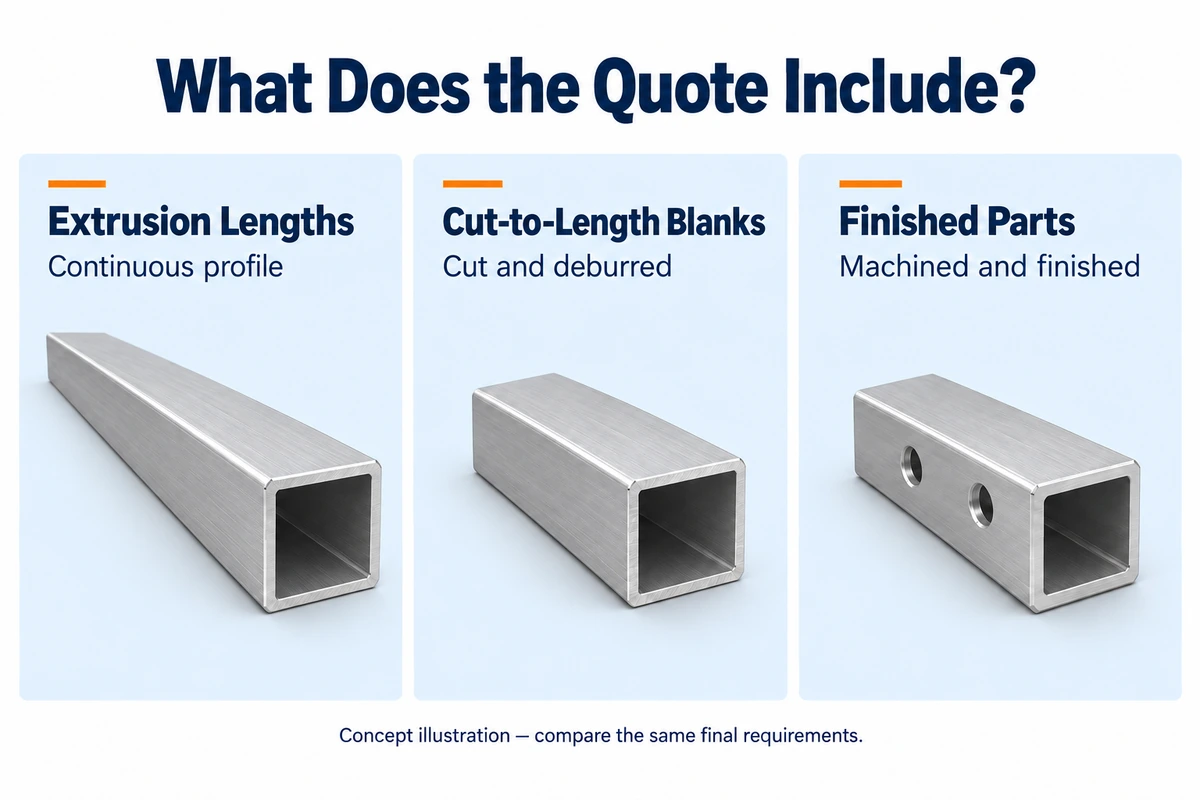
The same cross section can be supplied in long lengths, cut into blanks, or processed further into parts ready for assembly. Each option leaves different work to complete after delivery, so quotes need to cover the same requirements.
| Form supplied |
What to check in the quote |
Details needed for comparison |
| Extrusion lengths |
Extrusion, temper, and agreed surface condition; cutting and secondary operations may cost extra |
Supply lengths, cross-sectional and overall shape requirements, and billable weight or length |
| Cut-to-length extrusions |
Cutting, deburring, and length requirements; whether holes, threads, and end machining are included |
Quantity at each length, cut-end requirements, and planned secondary operations |
| Finished parts |
Holes, threads, mating surfaces, finishing, and agreed inspection and packaging |
Finished-part drawing revision, critical functional dimensions, and final acceptance requirements |
Whether pricing is per kilogram, pound, meter, foot, or piece, confirm the billing basis. Converting a weight-based price to a per-piece cost requires the cross section, part length, and billable weight. The finished part’s net weight after machining is not necessarily the weight billed for the extrusion. For long lengths, also check cutting allowances, remnants, and any minimum charges.
Separate Tooling Costs from Each Production Order
A custom cross section may require a new die and related tooling. Complex profiles, hollow sections, deep grooves, and dimensional or surface requirements can affect the tooling approach and cost. Check what the tooling charge covers, including trial extrusions, approval samples, and adjustments within the agreed scope.
Some quotes list tooling separately; others include it in the unit price. Do not add a tooling charge again if it is already included. For the first order, start with the parts total and add tooling, samples, packaging, and delivery charges not already covered. If different lengths or parts are priced separately, total those line items first.
For an order with a single part specification and the same delivery requirements, divide the order total by the corresponding delivered quantity to calculate the average purchasing cost per part. An average across mixed specifications should not be treated as the unit price for any individual specification. Spreading a fixed tooling investment over more parts reduces its average allocation per part. It does not reduce the actual upfront tooling expense or imply an automatic discount on the supplier’s unit price. Annual forecasts can support budgeting, but should not be treated as quantities already purchased in the first order.
For repeat orders, review the charges expected to recur. Confirm whether the existing die remains suitable, whether the drawing revision has changed, and how maintenance, modification, or replacement costs will be handled. Die ownership, storage, and transfer arrangements belong in the project agreement.
What Changes the Finished-Part Price
The cross section affects material use and production, but reducing weight does not necessarily lower total cost. Complex cavities, deep grooves, or uneven wall thicknesses can make tooling and manufacturing more difficult. Added machining or inspection to achieve a lighter design also affects the finished-part quote. See the Aluminum Extrusion Design Guide for related design considerations.
Material comparisons need both the alloy and the temper. Even with the same cross section, material, processing, and appearance requirements can lead to different production plans. If the grade is undecided, describe the loads, environment, and surface requirements. The 6061 vs. 6063 Aluminum Extrusion Guide can help inform that discussion; the material name alone does not establish which option costs less.
Tolerances should reflect part function and the condition supplied. Cross-sectional dimensions, straightness, twist, and final hole locations are separate requirements. Similar-looking profiles can have different finished-part costs once machining, fixturing, and inspection are included. Identify dimensions that affect assembly and specify the delivery stage they apply to. See the Aluminum Extrusion Tolerances Guide for more detail.
Finishing requirements also need to be specific. Color, gloss, exposed surfaces, masked areas, acceptable contact-mark locations, and protective packaging can change the quoted scope. For anodized parts, the Guide to Aluminum Anodizing Types and Applications provides process background. Final requirements still need to be confirmed for the project.
Compare Quotes on the Same Basis
A useful comparison checks each supplier’s included and additional charges against the same requirements. The table below provides questions to ask; it does not mean every item must be charged separately.
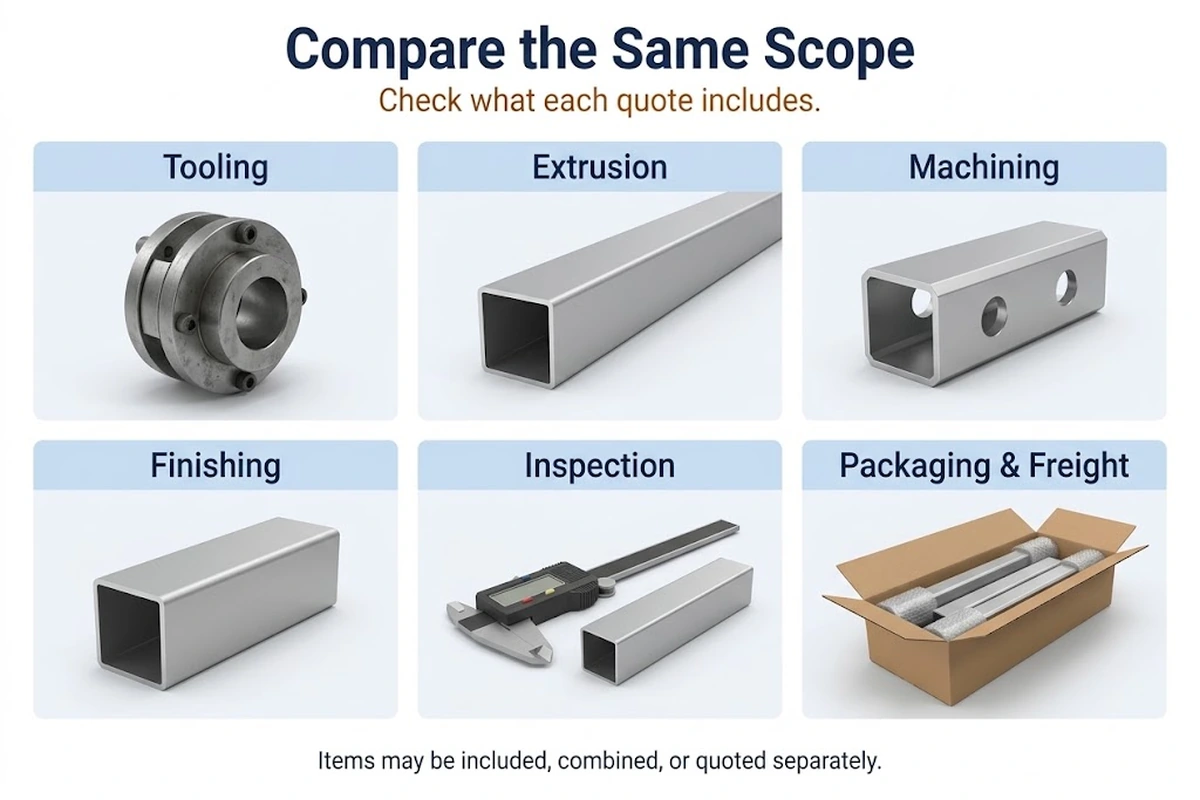
| Item |
Basis for comparison |
What to confirm |
| Quantities and pricing units |
Same part, length, order quantity, and billing basis |
Separate pricing for samples, first orders, and repeat orders; annual demand identified as a forecast or commitment |
| Tooling scope |
Same drawing revision and tooling scope |
Whether tooling is included in the unit price; coverage for trials, samples, adjustments, and later modifications |
| Machining and finishing |
Same finished-part condition |
Whether cutting, deburring, holes, threads, mating surfaces, and finishing are included |
| Inspection and documentation |
Same acceptance requirements |
Critical dimensions, measurement or inspection arrangements, and the scope of material and dimensional documentation |
| Packaging and delivery |
Same protection requirements, destination, and agreed terms |
Where packaging and freight charges are included; prices compared in the same currency |
| Quote validity and schedule |
Same purchasing stage |
Quote validity, sample arrangements, and production timing stated separately; whether changes require a new quote |
Suppose one quote covers cut blanks and another covers finished parts with threads and a surface finish. Compare both options against the same finished-part requirements. For the blank option, add the manufacturing, inspection, and delivery costs that are still needed and not already included in its quote. Do not count included items twice.
Provide Project Details That Reduce Pricing Assumptions
Readable cross-section and finished-part drawings with revision numbers connect the extrusion shape to the final requirements. Add the alloy and temper, form supplied, quantity at each length, critical dimensions, finishing and secondary-operation requirements, and target timing. List first-order quantities, repeat orders, and annual forecasts separately to support discussions about each purchasing stage.
If the design is still developing, a budget estimate or discussion of alternatives can be useful. Separate confirmed functional requirements from adjustable features and options still under review, so the preliminary quote’s assumptions are clear. Once drawings, samples, and scope are confirmed, check that the production quote still applies.
Some custom aluminum extrusion quotes take longer to prepare. The supplier may still be checking drawing revisions, assessing manufacturability and tooling options, or confirming costs for material, outsourced finishing, inspection, packaging, and freight. The supplier may also need to follow up to confirm quantities or delivery requirements that are still open. A longer wait does not, by itself, mean the review is more thorough. You can ask what still needs to be confirmed, what assumptions are being used, and when to expect an update.
Match Sample Approval to the Parts You Plan to Buy
Trial extrusion lengths, cut-to-length samples, and samples with secondary operations completed confirm different things. If assembly depends on final hole locations, threads, or surface condition, an unfinished extrusion sample cannot confirm those finished-part requirements. Sample quantity, condition, key checks, and documentation can be discussed before tooling begins. Approval should refer to the same drawing revision.
Apply the Cost Comparison to Your Project
Start with three steps: align the scope of supply, separate included charges from extras, and calculate first-order and repeat-order costs separately.
To discuss a specific project, contact Tongyong with the current drawings, purchasing quantities, and delivery requirements to review the scope of the quote.
References
Australian Aluminium Council — Aluminium Extrusion Manual December 2023
Aluminum Extruders Council — Aluminum Extrusion Dies & Tooling
Aluminum Extruders Council — Aluminum Extrusion Tolerances
 Have a Custom Aluminum Project?