Extruded Aluminum Heat Sink for Power Modules
A representative power-module heat sink case covering high-fin extrusion DFM, CNC finishing of the mounting face, and coordinated anodizing requirements.
A representative power-module heat sink case covering high-fin extrusion DFM, CNC finishing of the mounting face, and coordinated anodizing requirements.
With fins approximately 35 mm high and 1.5 mm thick, this heat-sink profile needed a full extrusion DFM review before tooling. The fins had to provide the required surface area without pushing the profile beyond a stable extrusion window, while the base still had to support power-module mounting and later CNC finishing.
The final design used 6063-T5 aluminum and measured approximately 180 × 120 × 45 mm, with an 8 mm base. After extrusion, the power-module contact face, mounting holes, and selected threaded features were CNC machined. The representative flatness requirement on the module mounting face was approximately 0.10 mm.
This case is based on our manufacturing experience with similar extruded aluminum heat sinks. Customer identity, equipment details, and original drawings are withheld; the values shown here are representative of this type of project.
| Item | Anonymized Representative Value |
|---|---|
| Product | Extruded aluminum heat sink for power modules |
| Material | 6063-T5 |
| Finished size | Approx. 180 × 120 × 45 mm |
| Base thickness | Approx. 8 mm |
| Fin thickness | Approx. 1.5 mm |
| Fin height | Approx. 35 mm |
| Main processes | Aluminum extrusion + CNC post-machining + anodizing |
| CNC-machined areas | Module contact face, mounting holes, selected threads |
| Module-face flatness | Approx. 0.10 mm |
| Inspection focus | Profile, fins, mounting face, holes, threads, and finished surface condition |
The profile was not released directly from the thermal concept into tooling. Fin height, thickness, and spacing were reviewed together with overall profile width, base thickness, and die geometry before the final extrusion section was approved.
Rather than increasing fin height or density in isolation, the design kept enough process margin for custom aluminum extrusion and the downstream machining steps. This allowed the section to be adjusted before tooling instead of relying on repeated corrections after initial trials. Related product configurations can also be seen in our aluminum heat sink range.
After extrusion, the power-module contact face was CNC finished, with mounting holes and selected threads completed in the same secondary-machining stage. The approximately 0.10 mm flatness requirement applied to the module mounting face rather than to the complete heat sink.
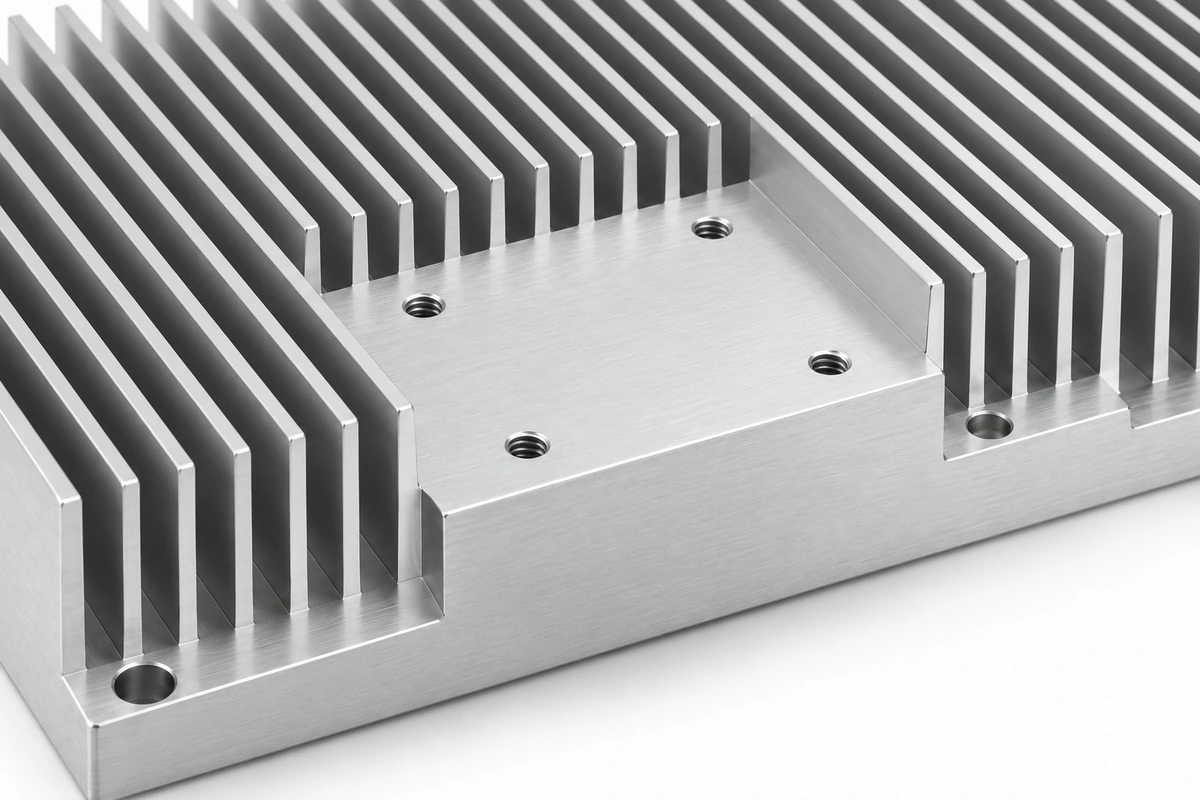
This kept precision where it mattered for assembly while leaving the main extrusion profile to do the bulk of the shaping. Base thickness, machining allowance, and the mounting region had already been coordinated during the manufacturability review, so the secondary operation did not require a redesign of the main section.
Anodizing was planned together with the module interface rather than as a separate cosmetic step. Depending on the module, electrical requirements, and drawing, the contact surface could be masked, left bare, or locally machined after finishing.
Final inspection focused on fin and profile condition, module-face flatness, mounting holes and threads, and the finished surface state. The 0.10 mm value is a representative project requirement; production acceptance remains tied to the actual drawing and module assembly conditions. Our quality and inspection process supports this type of dimensional and process verification.
If your project combines a high-fin extrusion, a power-module mounting face, CNC-machined holes or threads, or specific finishing requirements, send the 3D model together with a 2D drawing showing critical dimensions, tolerances, material, and mounting requirements. We can review the extrusion section, fin geometry, base, secondary machining, and finishing plan around the actual assembly. Contact us to discuss the project.
 Have a Custom Aluminum Project?
Share your drawing, 3D model, alloy and temper, critical tolerances, finish, and expected quantity. Our engineering team will review the profile and recommend a practical manufacturing approach.
FAQ
Yes, but fin height and thickness cannot be judged on their own. Fin spacing, profile width, base geometry, die design, alloy condition, and the actual press capability all need to be reviewed together before tooling.
Extrusion forms the overall heat-sink section efficiently, while the module mounting face usually has a more specific flatness and assembly requirement. Finishing this surface after extrusion concentrates precision on the functional interface instead of machining the entire heat sink to the same tolerance.
There is no universal rule. The surface may be anodized, masked, left bare, or machined after finishing depending on the module design, electrical requirements, interface material, assembly method, and customer drawing.
Upload your drawings or describe your requirements. Our team will review your inquiry promptly and provide initial feedback.
We use cookies to collect information about how you use this site. We use this information to make the website work as well as possible and improve our services.more details